


I am hearing despite increased investment in AI tools and employer sponsored AI training, employees are feeling over-whelmed by the pressure to keep up.
In a survey of 1,020 employed U.S. adults by ResumeNow finds 44% say they feel overwhelmed by the pressure to learn and use AI at work, and the same share said they lack a clear path for building AI skills.
Thirty percent said they were likely to spend their own money to learn those skills because they worried about falling behind. That is a telling signal for employers: access to AI tools and training is only part of the answer. Employees also need to set clear expectations and practical guidance on where to begin.
What Is Driving the Feeling of Being AI-Whelmed?
Fear and distrust of AI is behind this lack of confidence using AI at work. In a research study conducted among 150 C-Suite leaders by the University of Phoenix, leaders were asked what the biggest barriers were to use AI, they shared:
Fear and distrust of AI 87%
Ethical and security risks 55%
Loss of critical thinking by over relying on AI 38%
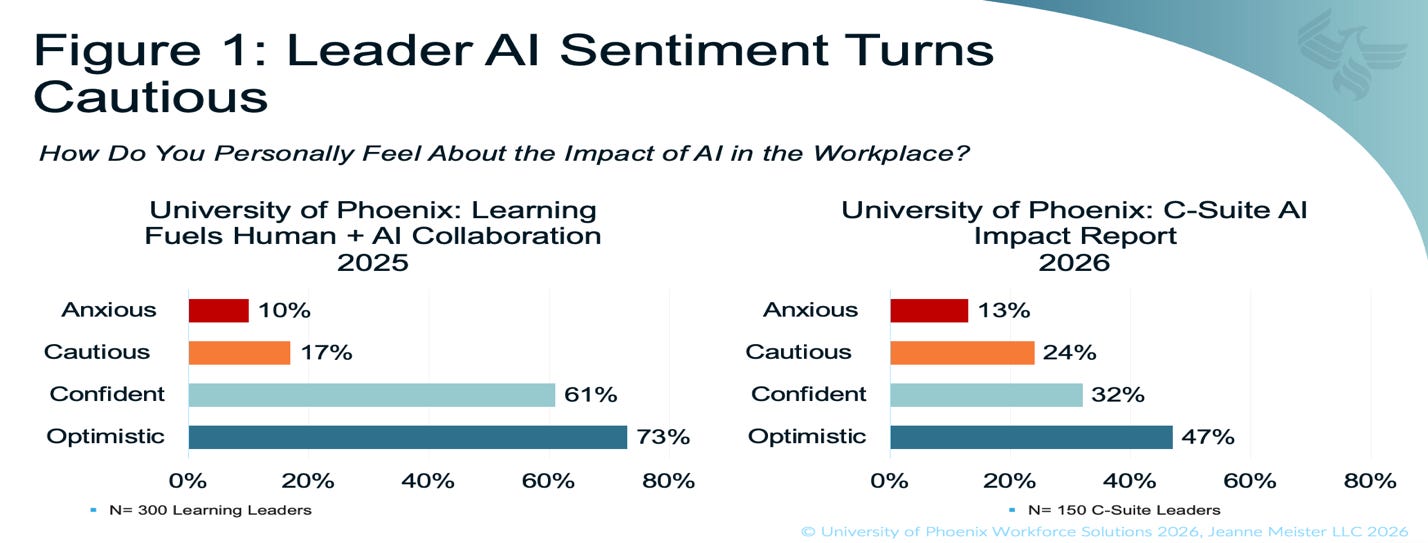
When these 150 C-Suite leaders were queried about how they personally feel about using AI at work, University of Phoenix found a decline in confidence and optimism using AI at work over a two-year period. See Figure 1
Biggest Fear: I Don’t Know How to Start Using AI
The biggest fear causing workers to be AI-whelmed is not knowing where to start building AI skills. Using AI can feel intimidating and fearful about where and how to get started building AI skills.
This means leaders need to be intentional about creating a culture of safe experimentation using AI at work. This can start with understanding how to conduct small experiments using AI for a few aspects of one’s day to day job to improve the quality and efficiency of work.
The goal is thoughtful usage of AI not just increased usage of AI.
What Can You Do For AI-Whelmed Workers? Pay Attention to AI-Well-being
1. Build AI-Wellbeing into your definition of employee well-being. Employee well-being is typically defined in five areas, but I believe a new one needs to be added:
o Financial Well-Being
o Mental Health Well-being
o Social Well-Being
o Physical Well-Being
o Career Well-Being
o NEW AI-Well-Being
I think a new lever needs to be created: AI-Well-being defined as thoughtful , responsible and healthy usage of AI. This means helping employees understand what the organization expects them to do with AI in their job role. Which tools are approved? How to access employer funded AI training? Where could AI help in a job? What does safe and responsible usage actually? How do one’s human skills of judgement and critical thinking play out when using AI at work? Without clear direction, employees feel uncertain and AI-whelmed.
1. Give employees time to experiment. Invite teams to try approved AI tools for tasks such as organizing research, brainstorming options, or drafting meeting summaries. An AI challenge half-day could give employees dedicated time to test one use case and share what worked, what failed, and what they would change.
2. Have leaders role model their usage of AI. Ask a leader to walk through a real task: what she asked AI to do, how she checked the output, and whether it improved the quality or efficiency of her work. Seeing the judgment behind the result can make AI use less intimidating.
Connect AI training to each team’s work. Use team meetings to discuss how existing AI training applies to specific goals. Make approved tools, prompt examples, employee tips, and opportunities to ask questions easy to find in one place.
4. Showcase the AI training that is already offered at your company. Use regular team meetings to discuss how AI training maps to the group’s specific KPI’s. But even when the share of companies offering AI training doubled from last year to this year, 43% of workers cite a lack of relevant AI training materials, according to research from Workera.
As AI fluency becomes essential to finding and keeping a job, leaders must recognize that the pressure to build these skills can affect employee well-being. Training alone will not ease that pressure. Although the share of companies offering AI-specific skills training rose from 25% to 58% between 2025 and 2026, employees still face uncertainty about how to use AI in their jobs.
Leaders can reduce this feeling of being AI-whelmed by setting clear expectations for using AI at work, giving employees time to practice and most importantly having leaders role model how they experiment with AI in their jobs. Without support, feelings of being AI-whelmed, will impact overall employee well-being.